Town water in Australian cities is treated and monitored against the Australian Drinking Water Guidelines, but what reaches your glass also depends on your pipes and, on tank or bore water, your own supply. Testing replaces guesswork with facts before you spend money on a filter.
Why test your water?
Testing shows what you’re dealing with, so you can choose the right fix or confirm you don’t need one. A filter chosen for chlorine taste won’t help with bacteria in a rainwater tank, for example.
It matters most if you rely on rainwater or a bore. Private supplies aren’t treated or monitored by a water utility, so checking quality is up to you.
Signs worth investigating
None of these signs proves there’s a health problem, but each is worth a closer look.
- A chlorine taste or smell. Utilities disinfect town water with chlorine or chloramine. It mainly affects taste, but it’s the most common reason people start filtering.
- Cloudy or milky water. If a glass clears from the bottom up after standing, the cloudiness is tiny air bubbles and harmless. Cloudiness that doesn’t settle is worth reporting to your utility.
- White scale on kettles, taps and shower screens. This usually means hard water, with more calcium and magnesium. It’s a cleaning and appliance issue rather than a health one.
- Blue-green stains in basins or showers. These usually come from corroding copper pipes, which is more likely when water is slightly acidic. The water may also taste metallic.
- Rust or brown staining. Common causes are older galvanised pipes, sediment stirred up by mains repairs, and iron or manganese in bore water. If discolouration keeps coming back, contact your utility.
- A rotten-egg smell, especially from a bore. This is usually hydrogen sulfide gas. If you only notice it on the hot tap, the hot water system may be the cause, so ask a plumber.
Start with your water utility’s report
On town water, a lot of testing has already been done for you. Utilities publish drinking water quality results, usually in an annual report, and many offer an online lookup for your suburb. Sydney Water, Yarra Valley Water in Melbourne, Urban Utilities in Brisbane, Water Corporation in Western Australia and SA Water are a few examples.
When you read the results, look for:
- Your supply area, because results can differ between treatment plants and supply zones.
- The disinfectant, whether chlorine or chloramine.
- Hardness, pH and total dissolved solids, which help explain scale and taste.
- Fluoride levels.
- PFAS results, which many utilities now publish.
Remember that these results can’t show what your own pipes and fittings add after the meter.
DIY test strips: a quick first look
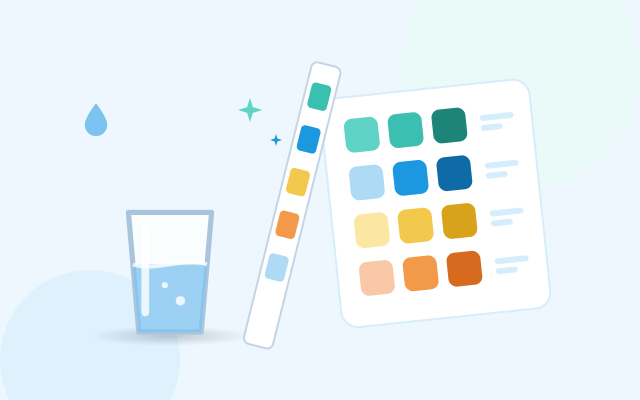
Test strips are cheap and easy: dip a strip, wait, then compare the colour pads with a chart. Depending on the kit, they give a rough reading for things like pH, hardness, chlorine, iron, copper and nitrate, which is handy for spotting obvious problems or checking that a filter is reducing chlorine.
They do have real limits:
- Results are ranges rather than precise numbers, and expired strips or poor lighting can mislead.
- Strips can’t detect PFAS, and they aren’t a reliable way to confirm water is free of bacteria or trace metals such as lead.
Treat a strip result as a prompt for further testing, not a final answer.
TDS meters: what the number does and doesn’t mean
A total dissolved solids (TDS) meter measures how easily water conducts electricity and converts that into an estimate of dissolved minerals and salts, in mg/L or ppm. It’s useful for comparing waters and for checking a reverse osmosis system, which should read much lower than your tap.
What a TDS reading does not tell you is whether water is safe. PFAS, lead at low levels, pesticides and bacteria barely register, if at all, while a high reading often just means more calcium and magnesium. The Australian Drinking Water Guidelines treat TDS as a taste issue, recommending no more than 600 mg/L for good palatability, rather than setting a health limit.
Laboratory testing: the most reliable answer
For a clear picture, use a laboratory accredited by NATA (the National Association of Testing Authorities, Australia). You can search for one on NATA’s website. The lab will supply sample bottles and instructions. Follow them closely, because how you collect and transport a sample can affect the result.
A lab test is the right choice when:
- You use tank or bore water. Health authorities recommend testing bore water for microbiological quality, such as E. coli, and chemical quality before drinking it. Tank water is worth testing too, particularly after storms or bushfires.
- You’re concerned about PFAS. PFAS are measured in nanograms per litre, and only specialised laboratory analysis can detect them.
- You suspect lead or other metals, for example in an older home with original plumbing.
- A DIY test flags something you’d like confirmed.
Ask which package suits your concern, because a basic drinking water test may not include PFAS or pesticides.
What to do with your results
- Compare them with the Australian Drinking Water Guidelines. Many lab reports show guideline values beside each result. Note whether each value is health-based or aesthetic (taste and appearance).
- Deal with anything health-related first. On town water, contact your utility if a result concerns you. For tank or bore water, your state or territory health department has guidance on treatment and safe use.
- Match the treatment to the problem. Sediment and chlorine suit sediment and carbon filtration. Bacteria in tank water call for UV disinfection with pre-filtration. Fluoride, PFAS and dissolved metals need reverse osmosis or media designed for them.
- Keep your report and retest. A baseline makes changes easier to spot, and a follow-up test confirms your treatment is working.